Interactive lab
Real outputs you can poke at
Three demos replay recorded results; the fourth runs its algorithm live in your browser. Each one says exactly what is real and what is schematic.
01Demo
Cobot fault detection: replay a recorded cycle
Pick a fault and play the cycle. The arm replays the recorded joint angles while the torque residual and tracking error are drawn against the band of 948 normal training cycles. When the cycle ends, the PCA detector and the Random Forest give the verdicts they actually gave.
Loading 13 recorded cycles…
- Real
- Joint angles, residuals and detector/classifier outputs for 13 recorded voraus-AD test cycles (one normal, one per fault: the median-scoring cycle of each category).
- Schematic
- The arm drawing uses generic link lengths and axes 1–4 only. It shows the recorded motion, not the robot's real geometry.
- Runs where
- Pre-computed by the project notebook; your browser only replays and plots it. No model runs here, and nothing is uploaded.
02Demo
Defect segmentation: inspect the C++ app case by case
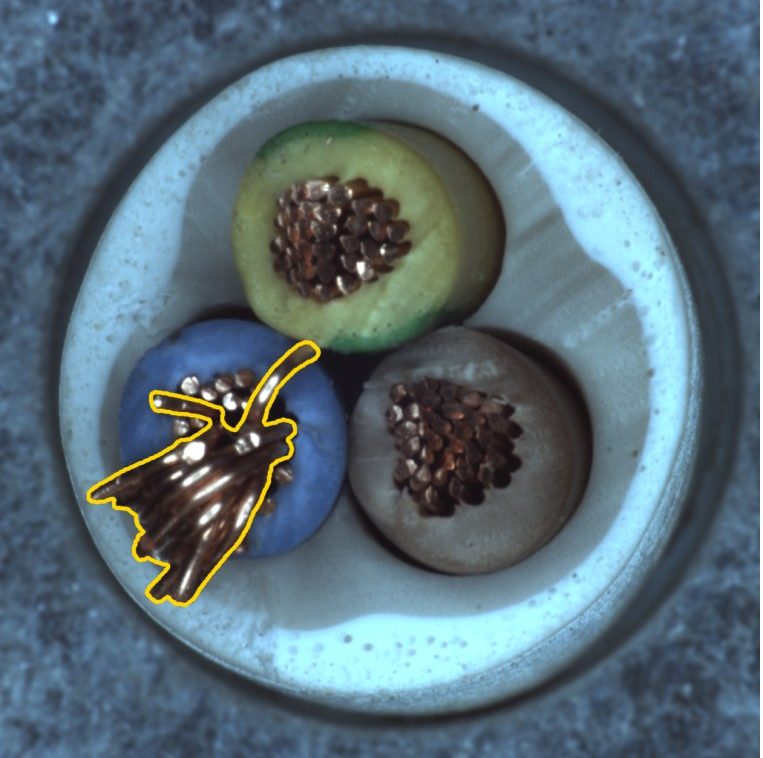
Drag the divider to compare the ground-truth outline with the mask the C++/TensorRT application produced. Failures are included and labelled.
17 held-out cases · 11 of 15 defects located at IoU ≥ 0.5
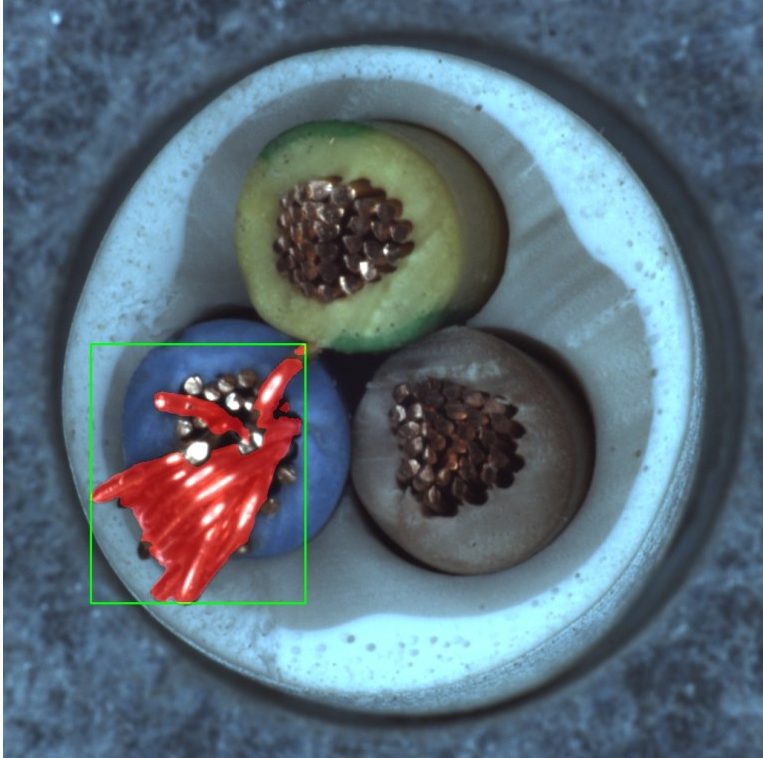 Ground truthC++ output
- Part
- Cable
- Defect
- bent wire
- Detection
- cable 0.91
- Mask IoU
- 0.79
Verdict: located
- Real
- Outputs saved from the C++/TensorRT application on 17 held-out MVTec AD images, with mask IoU scored against ground truth.
- Selection
- One random validation image per category (seed 0) plus two random defect-free parts. Failures are included.
- Runs where
- Pre-recorded. The engine needs an NVIDIA GPU, so nothing is inferred in your browser.
03Demo
Infrared detection: choose an operating point
Move the threshold to see the measured trade-off between finding 3–7 pixel targets and raising false alarms, and why 0.30 was chosen.
Detection vs false alarms per frame (log) · measured
- Detected
- 97.9%
- False alarms
- 0.0473 /frame
Chosen operating point: the tracker can reject an isolated false alarm, but it cannot recover a target the detector never reports.
- Real
- Detection rate and false alarms measured at each threshold on 12 held-out sequences (846 full frames).
- Scoring
- A detection counts when its centre is within 6 px of the target (IRSTD convention).
- Runs where
- A lookup over measured results; no inference in the browser.
04Demo
Sub-pixel registration: run it live
This one is not pre-recorded. Set a shift to a thousandth of a pixel, add sensor noise, and the phase-correlation algorithm recovers it in your browser on a 1/100 px grid.
Wafer pattern
- Truth
- (3.427, -5.184)
- Estimate
- …
- Error
- …
- Compute, your browser
- …
One shift is an anecdote. Run 50 random ones at the current pattern and noise.
- Real
- The registration runs live in your browser: a TypeScript port of the project's NumPy library, about 40 ms per 256×256 pair on a laptop.
- Checked
- Same estimate as the Python library on identical inputs for logic and DRAM patterns; within 0.09 px on patterns with spectral nulls, where FFT rounding decides (mean error within 1%).
- Differs from the notebook
- 256×256 instead of 512×512 and a browser random generator, so batch numbers will not match the notebook tables exactly. Nothing is uploaded.