Industrial defect segmentation with a C++ TensorRT app
I trained YOLO11-seg on MVTec AD to 0.82 mask mAP50, wrote the C++ TensorRT app that serves it, and found that rebalancing VisA's data lifted mask mAP50 from 0.25 to 0.41 where a bigger model did nothing.
- Role
- Dataset engineering, training experiments, evaluation and the C++ inference application
- Setting
- Offline evaluation on public benchmark images · C++ application run on a workstation GPU
- Stack
- Ultralytics YOLO11-seg
- TensorRT
- C++17
- CUDA
- OpenCV
- ONNX
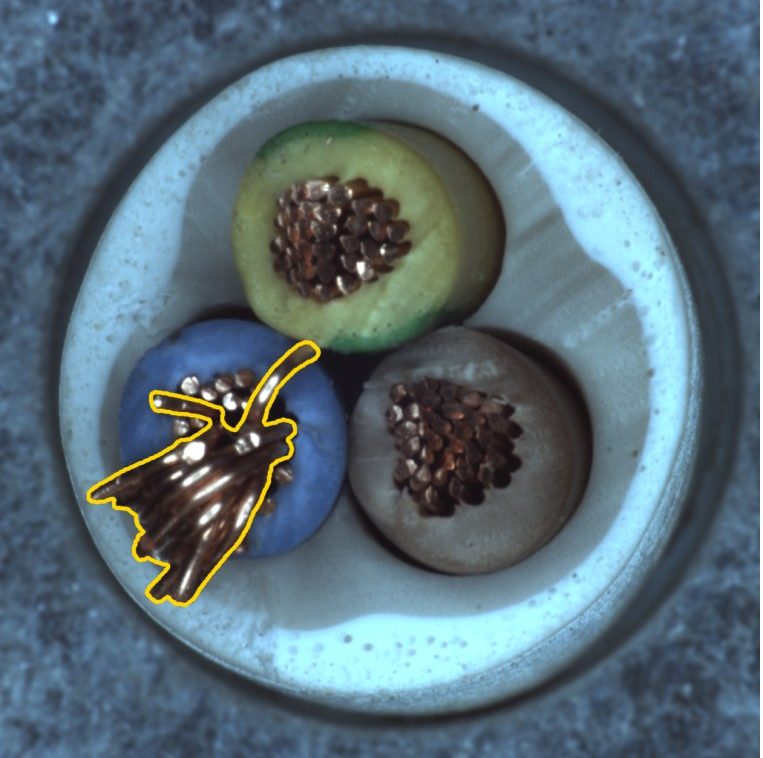
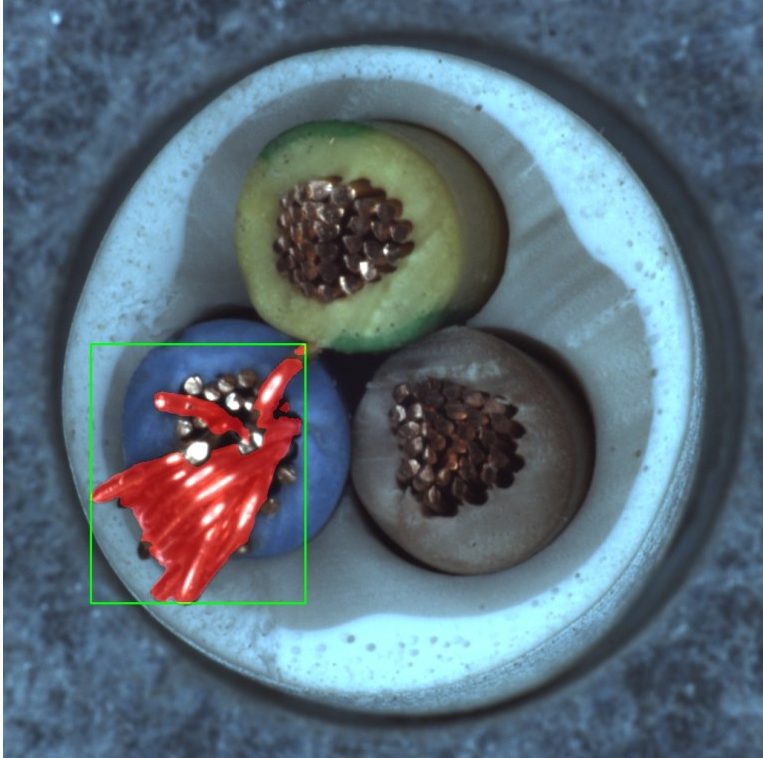 Ground truthC++ output
Key results
- mask mAP50 · MVTec AD
0.82
mask mAP50 · MVTec AD
15 categories, YOLO11l-seg 640 px
- VisA mask mAP50
0.25 → 0.41
VisA mask mAP50
training-set rebalancing only
- TensorRT YOLO11x-seg 1024²
6.7 ms
TensorRT YOLO11x-seg 1024²
mean, p99 7.2 ms (trtexec)
- false alarms on good parts
2.1%
false alarms on good parts
467 unseen defect-free parts, conf 0.5
01
Problem & constraints
Visual inspection needs a mask, not just a box: the defect's extent decides whether a part is scrap. The model must work on parts it has never seen and must not reject good ones.
Does a pixel-level detector trained on a few hundred defect images hold up on held-out parts, and what actually moves its accuracy?
02
My contribution
Dataset engineering, training experiments, evaluation and the C++ inference application
- Converted MVTec AD masks to YOLO polygon labels with an 80/20 split per defect type.
- Ran the VisA rebalancing experiment and the 2.2×-larger-model comparison.
- Measured false alarms on 467 defect-free parts the model never saw in training.
- Wrote the C++ app: pinned CHW buffers, async H2D/enqueueV3/D2H on one stream, NMS and mask reconstruction from prototypes.
- Scored the app's masks case by case against ground truth.
03
System architecture
01 · Data
data
MVTec AD
masks → polygons, 977 / 281
data
VisA
background = 10% of defects
02 · Train
model
YOLO11l-seg 640
model
YOLO11x-seg 1024
evolved hyper-params
03 · Export
process
ONNX → TensorRT
engine built with trtexec
04 · C++ app
system
Pinned buffers, CUDA stream
enqueueV3
process
NMS + mask prototypes
32×256×256
05 · Output
output
Box + mask + category
04
Method & key decisions
Data balance over model size
The two VisA runs have identical settings; only the share of background images changed (kept at 10% of the defect count). That removed a 20-epoch stall at zero and raised mask mAP50 by 16 points. A 2.2× larger model at 4× the pixels gave no gain on MVTec.
Mask decoding in C++
The app decodes 21,504 proposals × (4 box + 15 class + 32 mask coefficients). Each instance mask is sigmoid(coefficients · prototypes), upsampled and cropped to its box.
Fail loudly on stale engines
A TensorRT engine only loads with the version that built it. After an upgrade the app crashed on the old engine, so it now checks the load and says why.
05
Evaluation
- Dataset
- MVTec AD (15 categories), VisA
- Validation
- 281 MVTec images; the same split selected best.pt, so MVTec numbers are slightly optimistic
- C++ demo
- 1 random validation image per category (seed 0) + 2 random defect-free parts
- Hardware
- NVIDIA RTX 5080 (16 GB), CUDA 13, TensorRT 11
| Tile | 0.99 |
|---|---|
| Zipper | 0.97 |
| Bottle | 0.97 |
| Wood | 0.88 |
| Metal nut | 0.86 |
| Pill | 0.84 |
| Grid | 0.82 |
| Capsule | 0.81 |
| Hazelnut | 0.80 |
| Carpet | 0.78 |
| Toothbrush | 0.75 |
| Leather | 0.73 |
| Screw | 0.72 |
| Transistor | 0.69 |
| Cable | 0.67 |
Objects are harder than textures. Each category has only 6–31 validation images, so single-category differences are noisy.
| Run | Box mAP50 | Mask mAP50 | Mask mAP50-95 |
|---|---|---|---|
| MVTec · YOLO11l-seg · 640 px | 0.830 | 0.819 | 0.482 |
| MVTec · YOLO11x-seg · 1024 px · evolved | 0.831 | 0.823 | 0.473 |
| VisA · YOLO11l-seg · unbalanced | 0.281 | 0.250 | 0.118 |
| VisA · YOLO11l-seg · balanced | 0.457 | 0.410 | 0.214 |
06
Try it
17 held-out cases · 11 of 15 defects located at IoU ≥ 0.5
Ground truthC++ output- Part
- Cable
- Defect
- bent wire
- Detection
- cable 0.91
- Mask IoU
- 0.79
Verdict: located
- Real
- Outputs saved from the C++/TensorRT application on 17 held-out MVTec AD images, with mask IoU scored against ground truth.
- Selection
- One random validation image per category (seed 0) plus two random defect-free parts. Failures are included.
- Runs where
- Pre-recorded. The engine needs an NVIDIA GPU, so nothing is inferred in your browser.
07
Failures, limits & next steps
Right class, wrong extent
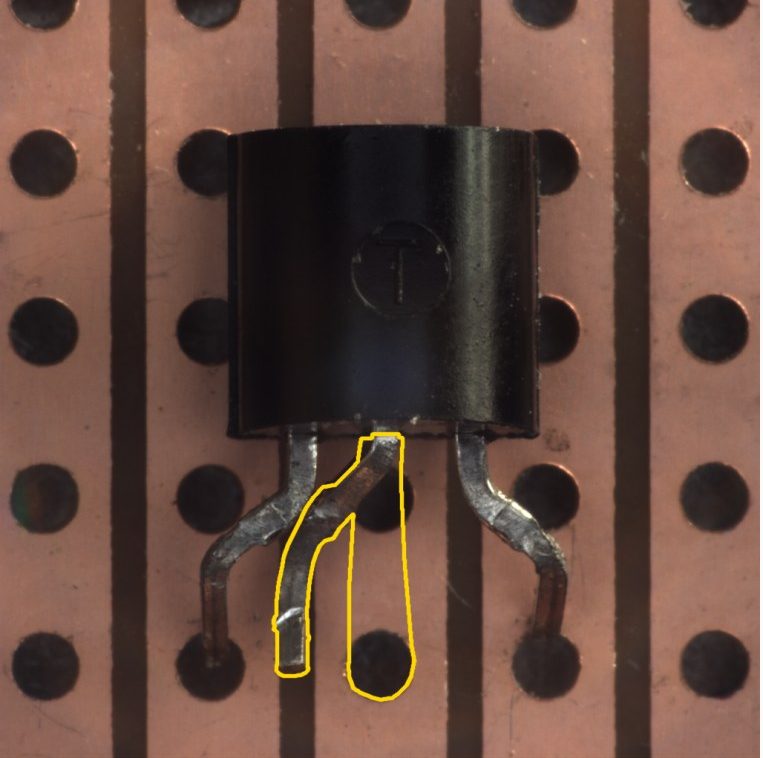
On the transistor's bent lead the mask spreads over the whole component (IoU 0.10). Shape and position defects are harder to delineate than surface marks.
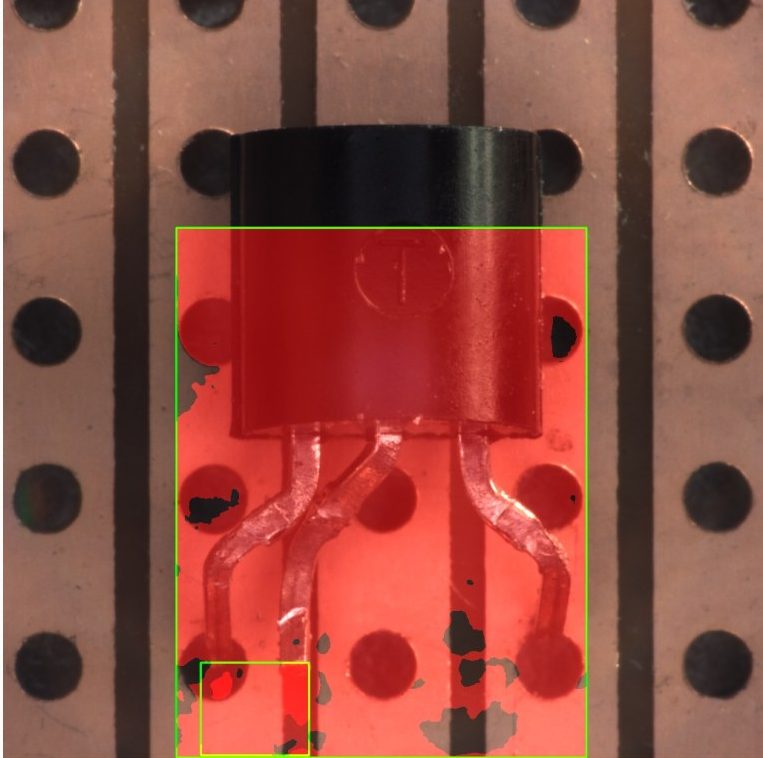 Ground truthC++ output
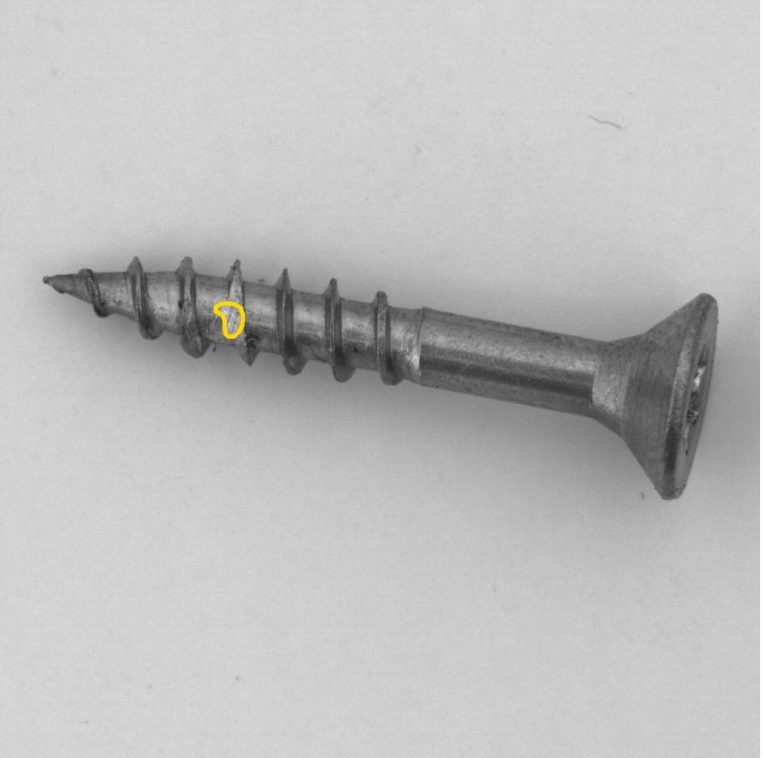
Missed: a 0.1% defect
The damaged screw thread covers about 1,200 pixels, 0.1% of the image, and nothing clears the app's 0.5 confidence threshold.
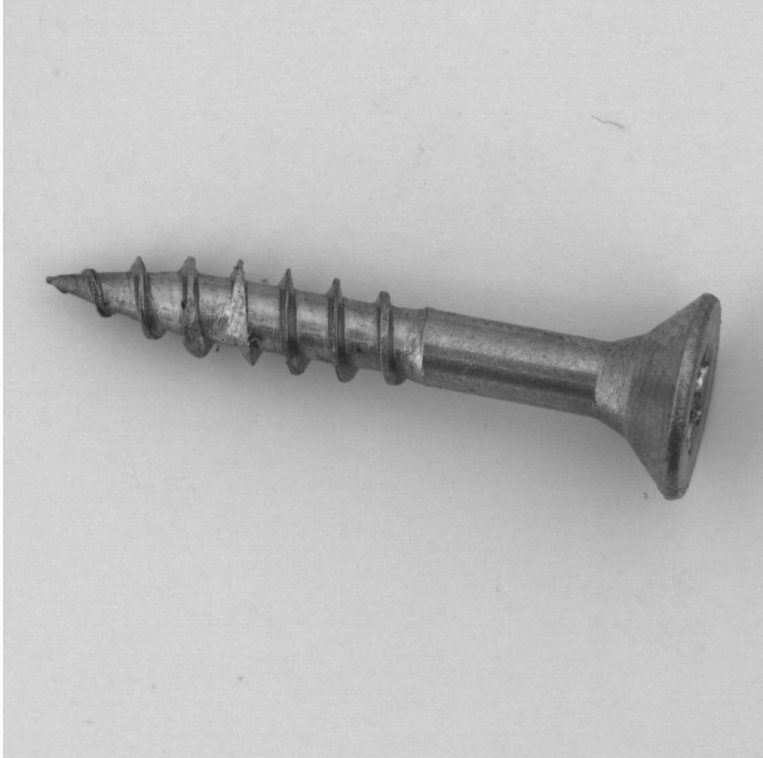 Ground truthC++ output
False alarm on a good part
A small surface speck on a defect-free hazelnut is flagged; the other defect-free part, a screw, stays clean.
Limitations
- No defect-free images in training; image-level AUROC and pixel-level PRO (the MVTec benchmark metrics) are not reported yet.
- Hyperparameter evolution finished 2 of 20 iterations on a 16 GB GPU.
- The engine is built from an FP32 graph; C++ end-to-end timing including pre/post-processing is not yet measured.
Next steps · what would prove it
- Train with defect-free backgrounds and report AUROC / PRO.
- FP16 export and end-to-end C++ timing.
- Smaller proxy model for hyperparameter search.
08
Code & references
- Bergmann et al., MVTec AD, CVPR 2019 (CC BY-NC-SA 4.0).
- Zou et al., VisA, ECCV 2022 (CC BY 4.0).
DataImages shown are model outputs on MVTec AD images, for non-commercial illustration with attribution.
Related projects
Next: Sub-pixel registrationComputer Vision · Edge Deployment
Real-time surgical tool detection, from dataset to device link
I validated a surgical-tool detector at 0.963 mAP50 over 5 folds, deployed it as a 0.87 ms TensorRT engine behind a Qt panel and a C++ serial relay, and measured an honest cross-dataset drop to 0.17.
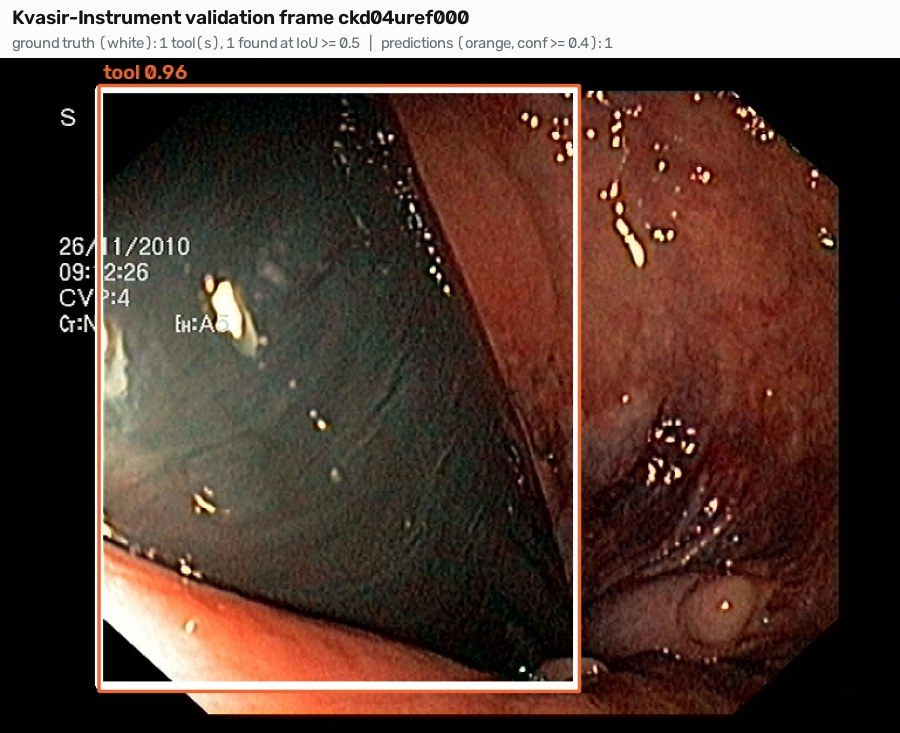
0.963mAP50 across 5 folds
Robotics · Signal Processing
Physics-grounded fault detection & diagnosis for a cobot
I built an interpretable pipeline on real cobot telemetry: an unsupervised detector flags faulty cycles at AUROC 0.944 with a 1.7% false-alarm rate, and a Random Forest names the fault.
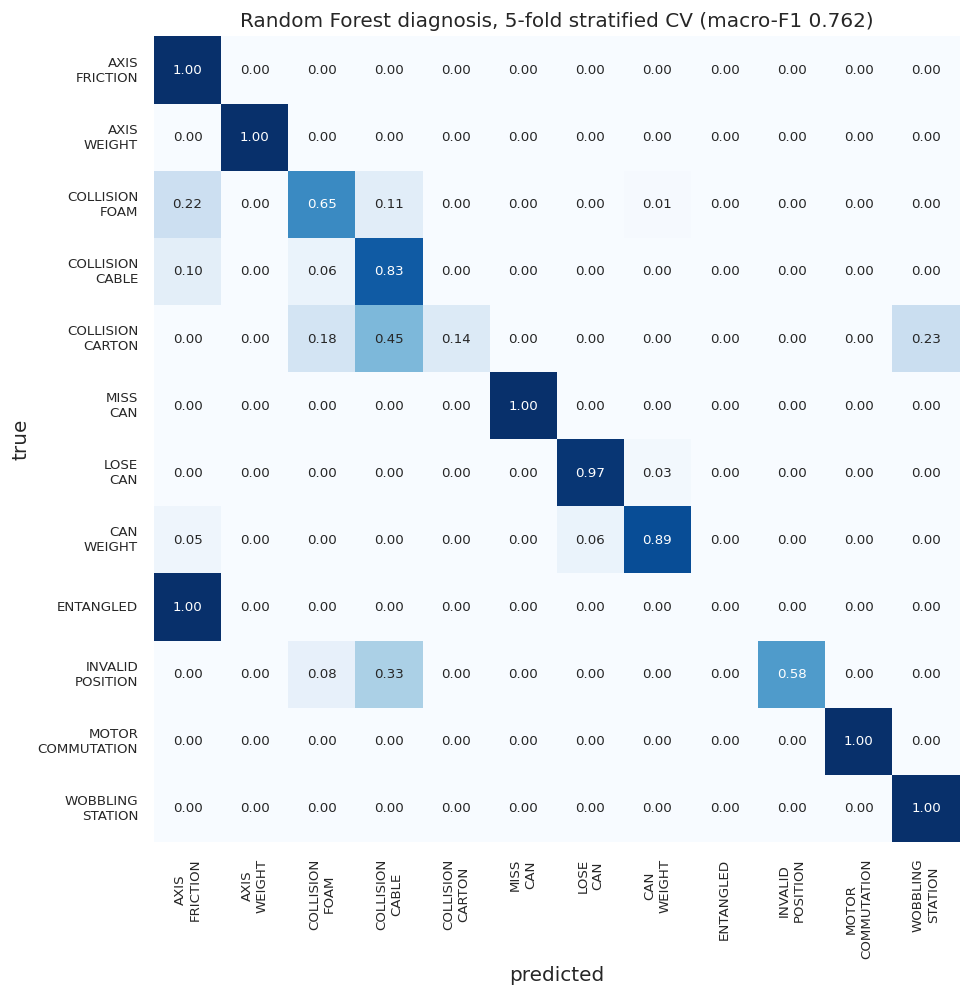
0.944AUROC, faulty vs normal cycles
Signal Processing · Computer Vision
Sub-pixel Fourier registration for wafer metrology
I implemented phase correlation with matrix-multiply DFT upsampling in NumPy: 1/100-pixel shifts that match scikit-image exactly on 50 of 50 tests, benchmarked across four wafer patterns and 15–40 dB of noise.
0.015 pxmean error on a DRAM array
Contact
Want to go deeper on this project? I'm happy to walk through it.
Open to full-time engineering roles. If the problem is hard and the data is messy, I'm interested.